

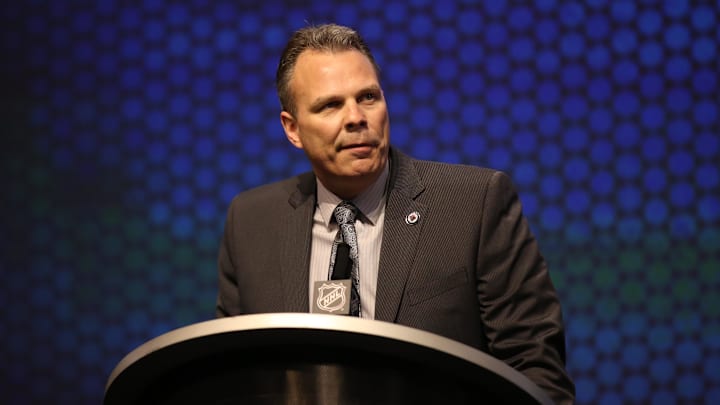
For those old enough (and so inclined), “The Process” is an indelible watershed moment—either as an act of managerial bravery or as a case of autocratic incompetence, depending on your team-building philosophy. Sam Hinkie, the former general manager of the Philadelphia 76ers (2013–2016), ushered in “The Process” era under the rubric of advanced analytics. His philosophy was that, to achieve greatness, you must put yourself in the best position to acquire elite assets. How do you do that? Tanking.
Objectively, his plan was a failure, but I contend that his premise was not. He executed it poorly, had some bad luck, and presented himself as an unlikable protagonist. But at its core, the idea is a good one. We’ll get back to this.
The Winnipeg Jets are frequently cited as the smallest market in the NHL. Columbus, Ottawa, Buffalo, and Florida all compete for this undesired distinction, but according to an anonymous player poll in The Athletic, the Jets sit atop most NHL players’ no-trade lists. This means Winnipeg is the least-favourite destination for NHL free agents.
This makes Kevin Cheveldayoff’s job difficult, but not impossible.
Consider the following: The Edmonton Oilers picked Connor McDavid and Leon Draisaitl first and third overall, respectively, in back-to-back drafts in 2014 and 2015. Between 2013 and 2017, the Avalanche drafted Nathan MacKinnon (first overall), Cale Makar (third overall), and Mikko Rantanen (tenth overall), all in the top 10. Sidney Crosby (first overall) and Evgeni Malkin (second overall) were drafted consecutively in 2004 and 2005. Victor Hedman (second overall) and Steven Stamkos (first overall) went back-to-back in 2008 and 2009.
What Does Tanking Do?
The point here is not subtle. The common thread is absolute futility for two to three years, with the reward being the acquisition of generational star players—not good players, but elite ones.
To be clear, a great deal more goes into team-building than acquiring elite talent. Building out a roster is a fragile tapestry. I also don’t want to conflate correlation with causation. The Oilers, Avalanche, Penguins, and Lightning have all had extended periods of greatness with the stars above, but by no means am I suggesting that landing talent of this nature is a complete solution in a vacuum.
What I am saying, however, is that it really, really helps. Who are the exciting, up-and-coming teams in the NHL right now? I would argue that the San Jose Sharks and Anaheim Ducks fit that bill. Macklin Celebrini, Will Smith, Leo Carlsson, and Beckett Sennecke were all drafted in the top five of the NHL Draft in successive seasons.
NHL Teams Tanking in the Past
The examples above highlight the importance of acquiring high draft picks, but tanking in the NHL is neither as flagrant nor as accepted as it is in the NBA. That said, there is precedent. For example:
i) The 1983–84 Pittsburgh Penguins: Often cited as the most overt example, the Penguins actively dismantled their team to secure the top pick for Mario Lemieux, including trading star defenseman Randy Carlyle and demoting their strong-performing goaltender, Roberto Romano, to the AHL in favour of the demonstrably worse Vincent Tremblay.
ii) The 2014–15 Buffalo Sabres: Sabres management dismantled the roster to maximize their odds of drafting Connor McDavid. Despite finishing last, they did not win the lottery, losing out on McDavid but drafting Jack Eichel—not a terrible consolation prize.
iii) The 2005–06 and 2006–07 Chicago Blackhawks: The Blackhawks deliberately retooled their roster, allowing them to draft Jonathan Toews (2006) and Patrick Kane (2007), which laid the foundation for their three Stanley Cup titles.
How the Winnipeg Jets Should Tank
This brings us back to the Winnipeg Jets. Any success (relative or otherwise) of the Winnipeg Jets 2.0 is primarily the result of savvy drafting early in the franchise’s inception. What do Patrik Laine, Nik Ehlers, Mark Scheifele, Kyle Connor, and Josh Morrissey have in common? They are all top-ten lottery picks (apart from Kyle Connor, who is universally recognized as a lottery gift).
I don’t think anyone would argue that the slate above represents generational talent, but rather very solid foundational drafting. The issue is that the Jets have not had a meaningful draft pick since 2016. As a small-market franchise, building through free agency is challenging, so the draft carries outsized importance for NHL relevancy.
The Winnipeg Jets’ 2025–26 season is all but over. From Presidents’ Trophy winner to the fourth-worst record in the league, the writing is on the wall for this iteration of aging stars. Kevin Cheveldayoff can either patchwork around the edges or embrace the skid—and usher in “The Process” of his own. Chevy needs to embrace the skid.
I recognize that the transactions that I am about to propose will not be popular with many and will be embraced by few. For 15 years, the Jets organization has attempted various forms of retooling in an effort to remain consistently relevant. That strategy has a shelf-life, one that has now reached its "best before" date.
Trade Connor Hellebuyck
For the Jets to tank effectively, Connor Hellebuyck must go. That is not an easy or natural statement to make. However, sentimentality is often the enemy of reality, so the Jets brass (and fans) can’t let Hellebuyck’s almost incalculable contributions get in the way of what’s best for the team’s future.
Trading Hellebuyck before the deadline accomplishes two things. First, the Winnipeg Jets were a dismal 3–9 when Hellebuyck went down with a knee injury, and—with all due respect to Eric Comrie—he will act as kerosene to a tanking inferno. Second, Hellebuyck is the Jets’ best trade asset. Coming off Vezina and Hart wins, and now an Olympic gold medal (yuck), I believe Hellebuyck could fetch multiple first-round picks. He is unquestionably the best goaltender in the NHL.
But is he? Quietly, Hellebuyck is having his worst season this decade. His Goals Saved Above Expected is 7.2, good for 20th in the league. For context, Hellebuyck led the NHL in this stat in each of the previous two seasons. He also has five years left on a contract that takes him to age 38. Historically, there isn’t a great track record for 38-year-old goalies.
Trade Kyle Connor and Mark Scheifele
Now to Kyle Connor and Mark Scheifele, who are in very similar situations. Both Jets legends are on the wrong side of 30 with long-term contracts. While not elite talent, they’re good enough to swing games—which you can’t have in a rebuild. The market may be reticent to take on large salaries for non-apex players, but I believe the Jets could garner youth and a first-rounder for each. I recognize that trading either player will be unpopular.
Josh Morrissey has two years remaining on a contract that pays him $6.25 million per year. Neal Pionk, the chaos agent, makes $7 million per year. I defy someone to make that make sense. Regardless, it does make sense to keep Morrissey through the 2026–27 season and look to capitalize at the trade deadline then. Pionk is—and will continue to be—like most things in Winnipeg: just something we have to live with.
That’s the blueprint. It is awkward and seemingly unnatural to trade away players who have made long-term commitments to the least desirable franchise in the NHL. Connor Hellebuyck, Mark Scheifele, Kyle Connor, and Josh Morrissey have all been excellent stewards of the Winnipeg Jets, and their contributions should be lauded. But you don’t win Stanley Cups with blind loyalty. Winnipeg can become a destination market with an influx of youthful talent—a 'process' Jets management should begin immediately.
 Add us as a preferred source on Google