

As we head into the Winnipeg Jets offseason, there are plenty of questions about the future of this team. There are some big issues to address, but also some low-hanging fruit when it comes to ways the Jets can improve next season. So, let’s address three of them. As Winston Churchill famously said, “To improve is to change; to be perfect is to change often.”
Uniforms
The current Jets logo and uniforms are decent too good, but why drive a Taurus when you have a Lamborghini in the garage? The red-panted throwback uniforms the Jets use sparingly are the way to go.
Winnipeggers are grateful to have the Jets back in Winnipeg and understand that Mark Chipman and David Thomson wanted to differentiate between Jets eras. It is time, though, to embrace the past and capitulate to the will of the masses. In the same way that the Vancouver Canucks should pivot to their alternate uniforms, the Winnipeg Jets should as well.
Will I be a bit melancholy to retire my old Nik Antropov jersey, procured after a historically misplaced bet with my friends? Sure. But the future is the past, and the Jets’ heritage uniforms are top five in the league. Keep the Jets 2.0 vintage alive as an intermittent callback, but this move would signal a new era for Jets hockey.
To quote the prophet, Deion Sanders, “If you look good, you feel good. If you feel good, you play good.”
Aggressive penalty kill
Over the past three years, the best teams at killing penalties are the Carolina Panthers, Tampa Bay Lightning, New York Islanders, and Colorado Avalanche. The Winnipeg Jets sit 22nd.
Above-average penalty killing is a consistent trait among recent Stanley Cup champions. Nine of the past 10 champions ranked in the top half of the league in penalty kill during the regular season, with many ranking in the top 10. While no one metric has a perfect correlation to playoff success, penalty kill, along with Corsi Close percentage and save percentage relative to league average, provides some of the strongest signal. For reference, Corsi Close measures the 5-on-5 shot-attempt differential — shots, misses, and blocks — between teams when the score is within one goal in the first two periods or tied in the third.
What trait do most successful penalty kills share? They are aggressive: aggressive in preventing entries into the defensive zone, and aggressive on the perimeter of the defensive box, reducing the space for power plays to operate.
The Winnipeg Jets have, for years, taken a conservative approach to the penalty kill. The theory is that if you tighten the box in your defensive zone, you limit the amount of cross-ice passing, thereby limiting scoring chances. You know what else reduces scoring chances? Not having the puck in your defensive end.
It is a copycat league, so why not employ the aggressive strategy used by the Carolina Hurricanes? For example, our best penalty killer remains Adam Lowry, who is not coincidentally our most aggressive. We have a Hart Trophy-winning goalie, so we can afford to be less risk-averse, which leads me to...
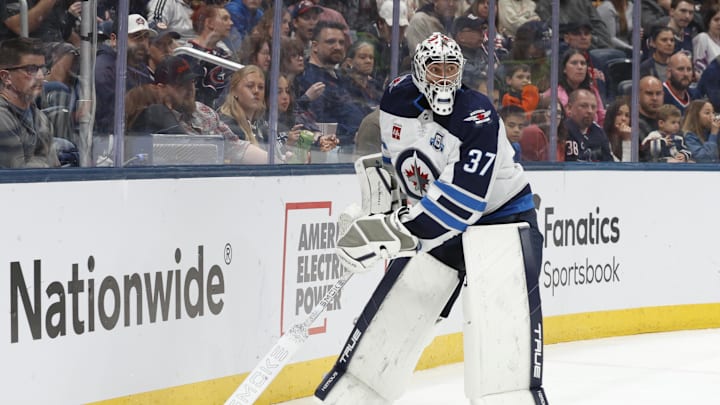
Connor Hellebuyck
Connor Hellebuyck’s comments during his recent media availability struck some as alarmist, to the point that speculation arose about his long-term future with the Jets.
First, his comments were refreshing. To paraphrase, he questioned the personnel changes Jets management made over the last offseason and indicated his desire to play on a team with legitimate Stanley Cup aspirations. Those are all-too-familiar sentiments for Jets fans.
Second, Hellebuyck has been an exemplary Winnipeg Jet, and I do not think his comments were tantamount to a trade request, but rather a warning. I have written a few times that, as currently constructed, the Jets project to be an old team next year regardless of what they do this offseason.
The website Hockey Graphs has quantified common sense when it comes to goalies: they do not age well. In short, its usage graphs suggest that a .920 save-percentage goalie — well above average — at age 35 will be at .909 in two years, which is quite below average, and .885 by age 40. Outliers like Dominik Hasek exist, but it is no mystery: goalies do not age gracefully. Hellebuyck will be 33 years old to start the 2026–27 season and will become a UFA at age 38.
My guess is that if the Jets have another year like the last one, Hellebuyck demands a trade. If the Jets were willing to acquiesce, they would then be negotiating from a position of weakness.
All of this is to say that the Winnipeg Jets need to give serious consideration to trading Connor Hellebuyck. This organization has a track record of holding onto assets past their “best before” date, and goalies are an even more fragile commodity. Such a move would entail a seismic philosophical shift for the Winnipeg Jets, but if it is going to happen, it should happen this offseason.
 Add us as a preferred source on Google