

If you want a fun manufactured game, create a BINGO card full of all the NHL player clichés sermonized during between-period interviews. You’ve witnessed these interviews — they sound vaguely like they were scripted by ChatGPT. Invariably, you will hear players talk about how “we gotta control the zone,” “get pressure deep,” and “control play.”
It makes for boring television, but to me, while some of it may be scripted, I think “system talk” is ingrained in NHL players. Every team claims to have a “system,” but the goal is usually the same — spend a greater proportion of time in your opponent’s zone and control the pace of play.
Offensively, there are essentially two ways to enter the zone: either through a controlled entry or a dump-in/forecheck. The most effective controlled-entry teams are generally those with players skilled enough to carry or pass the puck through transition. The most effective forechecking teams can be identified by high-pressure rates and puck-retrieval success. Basically, efficiency is measured by the percentage of dump-ins that turn into sustained possession.
The same holds true in the defensive end. Teams can be categorized as either dump-out or controlled-exit teams. The prevailing wisdom is that controlled entries and exits lead to more shots on net and a higher expected goals percentage. Dump-ins, or dump-outs, are safer, but ultimately you are giving the puck back to your opponent.
Some key metrics used to define system hockey include controlled-entry percentage, entry denial rate (defensively), dump-in recovery rate, and offensive-zone scoring chances after entry.
For a benchmark, let’s look at some of the top teams in the league. The Colorado Avalanche and Edmonton Oilers are elite controlled-entry teams that are speed-driven. The Carolina Hurricanes feature a dump-in-heavy approach but have elite retrieval. The Vegas Golden Knights feature a balanced, structured forecheck.
What type of team are the Winnipeg Jets, and why does that matter?
The data here is multi-sourced, but kudos to Cory Sznajder’s compilation on the All Three Zones website. The analysis provided covers a three-year span. Whatever your view of the Winnipeg Jets, it must be pointed out that since the start of the 2022–23 season, the Jets have the fourth-most combined wins during that stretch. They trail only the Carolina Hurricanes (1), Colorado Avalanche (2), and Dallas Stars (3). Moving forward, brackets will indicate a team’s placement in overall wins since 2022–23.
In what situations are the Jets creating their offense? Since 2022–23, the Jets have been an above-average dump-and-chase team and a below-average controlled-entry team. The Hurricanes (1) and Florida Panthers (10) are in an echelon of their own on the forecheck, while the Avalanche (2) and New Jersey Devils (14) are teams that excel at controlled entries.
However, that is just one piece of the puzzle. Whether you are gaining entry via a dump-in or a controlled entry, it matters significantly how you convert those entries into scoring chances. The Jets are above average at this, albeit not top 10 in the league. It comes as no shock that the Oilers (6), Tampa Bay Lightning (7), and Avalanche (2) lead the field in this metric.
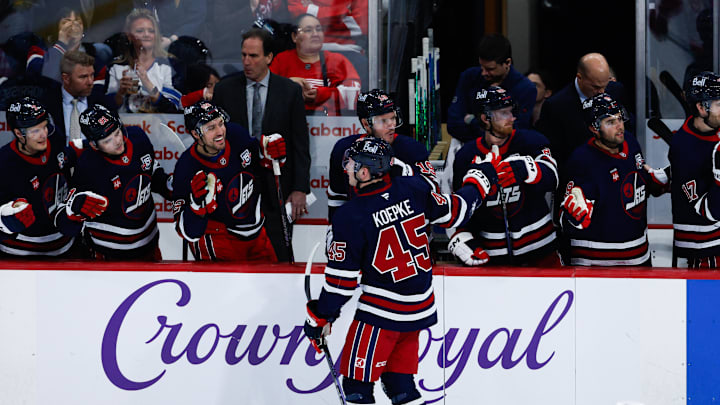
Statistically, who are the Jets best forecheckers? It’s who you might expect. Based on recovered dump-ins per 60 minutes, Cole Koepke and Morgan Barron lead the way. If you combine forecheck pressure per 60 minutes Koepke is the standout. He is a player that the Jets should strongly consider re-investing in. His speed is undeniable, and despite a lack of finishing touch, he is an ideal bottom six forward.
Controlled zone entries are calculated via zone entries per 60 minutes combined with carry-in percentage. From 2022-23, Nikolaj Ehlers recorded the three best combined tallies for the Winnipeg Jets. He keeps good company in this regard, keeping pace with Connor McDavid and Nathan McKinnon. Predictably, now the Jets rely on Mark Scheifele and Kyle Connor to carry the puck in, with Cole Perfetti being more proficient than I would have guessed. The issue is, beyond that, the Jets don’t have the personnel to control entry the puck. All the remaining Jets forwards are below average in this regard.
Where the Jets have excelled since 2022–23 is with controlled defensive-zone exits, although less so this year. That means the Jets have been effective at exiting their defensive zone with possession of the puck. They share this distinction with the Boston Bruins (5), Tampa Bay Lightning (7), and Vegas Golden Knights (8). This is why, in two of the last four years (2023 and 2024), the Winnipeg Jets have allowed the fewest goals per game in a season. Their Vezina-calibre goalie certainly plays a significant role, but the Jets’ gameplay in their own end has also contributed to this success.
Of note is that Dylan Samberg and Josh Morrissey are struggling this year with zone exits, comparatively speaking. The freshly departed Logan Stanley and Luke Schenn definitively fell in the dump-out camp, so any physical presence they provided is mitigated by replacement level puck play.
The Jets are less adept at retrieving the puck in the defensive zone to initiate a breakout, or at preventing chances once a defensive entry has occurred, but they are still slightly above average in both areas. They have also been middling in neutral-zone transitions, but there tends to be more variation in neutral-zone play.
In sum, since 2022-23, the Jets have been above average at controlling play in the offensive end and, at times, outstanding in the defensive end. However, the Jets are stuck between identities — without the transition skill of elite rush teams or the forecheck dominance of dump-and-chase contenders. Their structure, for the most part, works defensively, but it caps their offensive ceiling against top-tier teams.
This may be stating the obvious, but typically your more skilled players factor into controlled zone entries or exits, while your less skilled players dump pucks to avoid being checked. Since 2022–23, the Jets have offensively chosen to go for the lower-risk entries, which has increased the importance of their forecheck. The moves the Jets made this summer significantly reduced the speed of the team, which in turn impacted the forecheck. It also had an impact on their ability to skate the puck out of the defensive zone. In short, you can’t be a slow dump-and-chase team, nor can you expect your slower players to carry the puck out of the defensive zone.
If the Winnipeg Jets truly want to compete with the likes of the Avalanche, Panthers and the Oilers, they need to be better than above average with their control of play. With their roster set, the way to do this is either through better scheming, which would mean a coaching change, or through more adept players, which would mean action from the general manager. Despite the social media buzz, I don’t think Scott Arniel is going anywhere, and neither is Kevin Cheveldayoff, so this appears to be a battle of attrition.
So that’s the Jets’ BINGO card in the end: structure, support, puck management, pressure deep. They can check a lot of the right boxes, and over 82 games that has made them a very good team. But against the league’s best, very good is not the same as truly threatening. Until Winnipeg adds more speed, more skill, or a system better tailored to the roster it actually has, the clichés will keep sounding familiar — and so will the ending.
 Add us as a preferred source on Google