

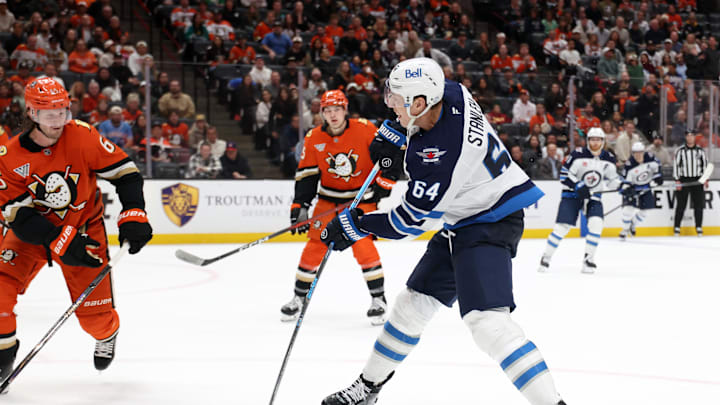
Logan Stanley is an enigma: a gangling albatross to some, and a towering highlight reel to others. Drafted 18th overall in 2016, Stanley’s path to NHL relevancy has been unarguably tumultuous. Now, as an unrestricted free agent, the Winnipeg Jets have a decision to make—do they re-up the lanky defenceman, or trade him to the highest bidder?
To understand his utility, we need to analyze his value. Traditional analysis dictates that big-bodied defencemen with offensive capabilities are an asset. Let’s break that down.
Is Logan Stanley a good defensive defenseman?
Analytically, the answer is no. According to Evolving Hockey, across his NHL career, Logan Stanley has been a below-average defender. How below average? Essentially, he ranks in the worst 5% of all NHL defencemen. His “Expected Goals Against per 60” sits in the bottom quadrant of NHL defensemen tracked. That means teams have a much better chance of scoring against the Winnipeg Jets when Logan Stanley is on the ice.
Logan Stanley tries, so it's difficult to match the numerical analysis above with traditional scouting. That said, Stanley still frequently finds himself out of position on the defensive end, and as a result, is third overall in the NHL in minor penalties this year, despite a comparatively diminutive playing time.
Is Logan Stanley a good offensive defenceman?
Up until the 2025–26 season, the answer to this question would also have been no. However, Stanley has undergone a bit of an offensive renaissance. He is the Jets’ sixth-best goal scorer this year (nine goals), shattering his previous career high of one goal in each of his previous five seasons.
My first thought was that his recent offensive output must be the result of increased usage. I was partly correct. While Stanley has seen an uptick in overall ice time, his shooting percentage has jumped from 3.95% over the past four years to 14.1% this year.
MoneyPuck’s “Goals Above Shooting Talent” (also referred to as “Shooting Talent Above Average”) measures a player’s ability to score more goals than an average player given the same scoring opportunities. The metric is based on a player’s historical track record of exceeding their expected goals. Logan Stanley leads the Winnipeg Jets this year in this category—and by a wide margin.
As such, all signs point to an anomalous offensive season.
Does Logan Stanley provide the grit the Winnipeg Jets need?
The utility of fighting in hockey is a topic for another article, but for proponents of the sport’s pugilistic side, Logan Stanley is Winnipeg’s (hockey) version of Donnie Lalonde—albeit less successful. Over the past two years, Jets players have engaged in 27 fights. Logan Stanley has been involved in nine of them, the highest per-game rate of any Jets player.
This means Logan Stanley is a willing fighter. I appreciate that. “Scrapper” is a hard job and—regardless of personal preference—one that still has a place in NHL hockey.
What does this mean for Logan Stanley’s NHL future with the Winnipeg Jets?
As mentioned, the Winnipeg Jets should be reconsidering their direction. Statistically, Logan Stanley profiles as a journeyman, bottom-pair defenseman. So, if the Jets can cash in on his offensive surge this year, they should capitalize on the opportunity. In short, Logan Stanley should not be part of the Winnipeg Jets' long-term plans.
 Add us as a preferred source on Google